
By Broden Design Group | Last reviewed: October 2026
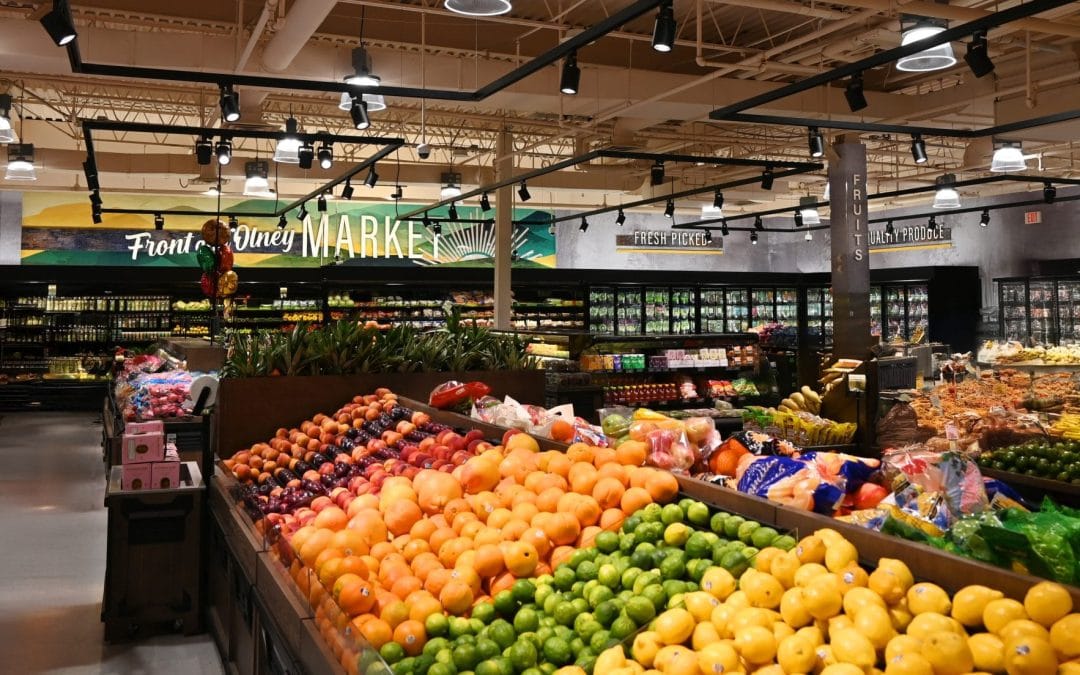
Produce department design shapes how shoppers judge the entire supermarket. A well-designed produce section makes fruits and vegetables easy to see, encourages customers to explore, and signals freshness and quality within seconds. Better displays, lighting, custom signage, and flexible fixtures can lift the department without a full rebuild, as long as the changes are tied to measurable goals like sales per square foot and shrink.
The stakes are real. U.S. fresh produce generated $97 billion in sales, with unit sales up 2%, according to FMI’s The Power of Produce 2026. For many stores, produce is also the first department shoppers walk into, which makes it the store’s first argument for what the rest of the building stands for.
But an attractive produce department also has to work behind the scenes. Employees need to replenish efficiently, shoppers need room to navigate, and fixtures must handle products with very different weights, handling needs, and storage requirements.
At Broden Design Group, supermarket design, custom signage, fabrication, and installation are core specialties. Here’s how we think about a produce refresh that balances visual impact with everyday operations.
Key Takeaways
- Produce often sets a shopper’s first impression of the store’s freshness, quality, and cleanliness.
- Fruit is driving category growth: per FMI’s Power of Produce 2026 data, fruit makes up nearly 56% of produce volume, and berries accounted for about a third of fruit’s new dollars in 2025. Give growth categories the best real estate.
- Effective produce department design balances abundant displays with clear pathways and efficient restocking.
- Signage, lighting, and coordinated finishes improve product visibility and department identity.
- Flexible fixtures and a dedicated seasonal zone make it easier to merchandise changing assortments.
- A visual refresh doesn’t always require replacing refrigeration or rebuilding the department.
- Measure sales, margin, shrink, and restocking time before and after any changes.
Why Is Produce Department Design So Important to Supermarket Sales?
Produce sets the tone for the whole trip. Organized displays, strong color, clean finishes, and clear signage reinforce a sense of freshness. Tired décor, cramped pathways, and inconsistent signs make a department feel dated, even when the product itself is fresh.
Strong produce department design supports several business goals:
- Product discovery: Clear displays make seasonal and specialty items easier to notice.
- Navigation: Intuitive pathways help shoppers find what they came for.
- Merchandising: Flexible fixtures create space for features and promotions.
- Brand perception: Coordinated design communicates the store’s identity.
- Shopping comfort: Appropriate aisle widths and display heights make browsing easier.
Shopper behavior is shifting too. FMI reports that Gen Z and millennials increasingly discover new produce and preparation ideas through social media and digital platforms. That makes in-store prompts, like recipe signage, meal-idea displays, and QR-linked content, more valuable than they were a few years ago.
The Importance of First Impressions
When produce sits near the entrance, it’s one of the first signals customers get about the store. Entrance sightlines matter. A strong focal display draws shoppers toward fresh product, but crowding the entry with oversized fixtures or competing promo signs makes the space harder to navigate. Broden’s retail design FAQ notes that produce, bakery, deli, and prepared foods are often positioned near the entrance for exactly this reason.
What Makes a Great Supermarket Produce Department Design?
A great produce department makes products easy to identify, reach, and compare, while giving employees room to restock and maintain displays. Key characteristics:
- Clear shopping paths with accessible routes
- Display heights that preserve sightlines across the department
- Logical groupings of fruits, vegetables, and specialty items
- Lighting that presents products accurately without excessive glare
- Consistent department and promotional signage
- Fixtures built for frequent cleaning and daily use
- Flexible space for seasonal merchandising
- Appropriate refrigeration and handling conditions for each product
The best design isn’t the one with the most elaborate fixtures. It’s the one that stays attractive, functional, and manageable through a full shopping day, including the 6 p.m. rush.
10 Produce Department Design Ideas That Can Help Increase Sales
1. Make the Entrance Feel Fresh and Inviting
When produce is near the entrance, the first few displays deserve the most attention. Use one coordinated focal display of colorful, seasonal products rather than several competing signs. The entry should communicate abundance while leaving room for shoppers to orient themselves.
Practical improvement: Stand at the entrance and note what catches your eye first. If it’s a sign, a stack of baskets, or a promo table instead of fresh product, start there.
2. Improve Produce Department Layout and Customer Flow
Display islands organize merchandise, but their placement has to account for carts, shoppers stopping to select product, and employees restocking. High-demand items in the wrong spot create bottlenecks.
Practical improvement: Watch the department during peak hours. Note where carts pile up, where shoppers turn around, and where displays interrupt natural paths. Maintain accessible routes and coordinate significant layout changes with qualified design professionals.
3. Upgrade Produce Displays and Merchandising Fixtures
Depending on the department, this might mean tiered displays, angled surfaces, custom merchandising tables, or modular fixtures that can be reconfigured. Design must account for product weight, handling, cleaning, and restocking. A fixture built for packaged berries isn’t right for bulk potatoes.
Practical improvement: Flag fixtures that always look underfilled, are hard to replenish, or block product visibility. Broden’s in-house fabrication can produce custom displays and decorative elements tailored to a department’s layout.
4. Use Lighting to Highlight Freshness and Color
Lighting changes how produce looks. Poor placement creates dark spots, glare, or uneven illumination that makes product harder to evaluate. A lighting plan should weigh visibility, color rendering, glare, energy efficiency, heat output near product, and compatibility with existing systems.
Practical improvement: Walk the department during normal hours and note displays where the product looks shadowed or dull. Plan changes with qualified electrical and lighting professionals.
5. Create Stronger Produce Department Signage
Overhead department identifiers, category signs, promotional graphics, and specialty labels each do a different job. A good system is readable from the right distance and consistent with the store’s brand.
Broden’s signage and wayfinding work includes department signs, dimensional lettering, illuminated elements, suspended signage, hanging aisle markers, and promotional displays. Its hanging produce sign at ShopRite of Hyland Plaza is one example.
Practical improvement: Look for the produce department from several main aisles. If shoppers can’t spot it, or can’t find major categories once inside, the signage isn’t working. Hanging signs over walkways also need adequate headroom; generally at least 80 inches of clearance along circulation paths.
6. Introduce Natural-Looking Materials and Decorative Finishes
Wood-look treatments, botanical graphics, coordinated colors, and market-inspired elements help create a fresh, inviting atmosphere. But materials must survive frequent cleaning, misting, and constant traffic.
Broden manufactures custom wallcoverings and environmental graphics, including printed finishes that reproduce realistic material looks, giving a department the feel of a pricier architectural treatment without the cost.
Practical improvement: Identify dated walls, mismatched finishes, or blank surfaces that could carry coordinated department graphics.
7. Improve Product Grouping and Cross-Merchandising
Product arrangement can make shopping more convenient and drive discovery. Grouping salad ingredients in a logical sequence simplifies meal planning, and seasonal displays introduce items shoppers might otherwise skip. FMI’s 2026 research found vegetables lag fruit in growth and are still concentrated at dinner, which makes meal-idea merchandising (breakfast veggies, snack packs, sheet-pan dinner sets) a real opportunity.
Practical improvement: List the top customer missions (salad night, kids’ snacks, seasonal entertaining) and check whether the department makes related items easy to find. Involve your produce manager, who knows purchasing patterns and handling requirements.
8. Create Flexible Seasonal and Promotional Displays
Assortments change all year: berries in summer, apples in fall, citrus in winter, plus holidays. Flexible fixtures and easily updated signage handle these shifts without permanent modifications each season.
Practical improvement: Reserve a clearly defined seasonal zone near the department’s entry point and design its signage so it can be swapped quickly.
9. Balance Visual Abundance With Freshness and Inventory Management
A produce department should look full, but abundance can’t come at the expense of quality. Oversized displays may require more inventory than the store can sell before quality declines, and heavy stacking damages delicate items. Smart fixture dimensions, false bottoms, and presentation angles create a full look with less product on the table.
Practical improvement: Review displays with high shrink or constant replenishment problems, and determine whether the fixture or the merchandising practice is the cause.
10. Refresh the Department Without Rebuilding It
Not every produce department needs a full renovation. Updated signage, wall graphics, decorative finishes, and selected fixtures can create a noticeably different department without major construction, especially when refrigeration, flooring, and layout still work.
Practical improvement: Sort the department’s problems into three buckets: visual, merchandising, and infrastructure. Fix the visual and merchandising issues first before committing to a larger renovation.
Produce Department Refresh Ideas by Budget and Project Scope
| Project Scope | Potential Improvements | Best For |
| Visual refresh | Updated signage, graphics, decorative finishes | Functional layouts with dated appearances |
| Moderate renovation | Selected custom fixtures, display reconfiguration, lighting changes | Improving presentation and shopping flow |
| Major redesign | Layout changes, equipment replacement, flooring, comprehensive décor | Departments needing significant operational and physical change |
These are illustrative project categories, not standardized Broden packages.
A visual refresh typically involves fewer construction trades, while a major redesign requires more coordination. Actual costs depend on department size, materials, fabrication, installation conditions, and any equipment or infrastructure changes.
How Can Better Produce Merchandising Support Higher Sales?
Design creates better conditions for discovery and purchase, but revenue depends on more than appearance. Pricing, assortment, quality, promotions, staffing, and in-stock rates all matter. Set baselines before the refresh and compare afterward.
| Performance Metric | What It Helps Evaluate |
| Produce sales per square foot | Productivity of department space |
| Department revenue | Overall sales performance |
| Gross margin | Profitability of produce sales |
| Units per transaction | Changes in purchasing behavior |
| Average basket value | Broader shopping trends |
| Shrink and spoilage | Inventory loss and product handling |
| Promotional sales | Performance of featured merchandise |
| Restocking time | Operational impact of fixture and layout changes |
Compare equivalent periods and account for seasonality, promotions, pricing, and assortment changes. A summer sales bump after a spring refresh may reflect the berry season as much as better presentation. The most reliable evaluation combines sales data, operational observations, and customer feedback.
Before-and-After Produce Department Design: What Should Change?
| Common Problem | Potential Design Improvement | Intended Benefit |
| Poor department visibility | Stronger overhead signage | Easier navigation |
| Crowded, flat displays | Reorganized or tiered fixtures | Better product visibility |
| Dated wall finishes | Coordinated graphics and décor | Updated visual identity |
| Confusing pathways | Better fixture positioning | More comfortable circulation |
| Inconsistent promotional signs | Coordinated signage system | Easier merchandising updates |
| Limited seasonal space | Modular display features | Greater promotional flexibility |
These changes improve the shopping environment, but financial outcomes should be measured, not assumed.
How Broden Design Group Approaches Produce Department Design
Broden Design Group has specialized in supermarket design, custom fabrication, signage, and installation since 1990. Its services include supermarket layout and department planning, 3D renderings, custom signage, decorative finishes, in-house fabrication, and installation for new and operating stores. Read more about our approach to designing a grocery store that keeps customers longer.
ShopRite of Commerce Park: Transformed Fresh Departments
At the remodeled ShopRite in Stamford, Connecticut, Broden provided the modern interior décor as the store transformed its produce, meat, seafood, and bakery departments alongside a new exterior façade.
Fresh Grocer of Brooklyn: Produce at the Front
In the 18,000-square-foot basement Fresh Grocer of Brooklyn, the layout places produce and sushi at the entry, with a vibrant department palette and continuous floor striping guiding shoppers through a windowless space.
ShopRite of Fairfield: A Market-Style Produce Concept
Broden’s site describes the Cingari Family Markets ShopRite of Fairfield, Connecticut, design as featuring an open, market-style produce area contrasted with a more intimate, service-focused zone. The expanded 54,328-square-foot store celebrated its completed renovation in September 2026 and remained open throughout the work, according to local coverage.
Explore Broden’s Supermarket Design and Fabrication Services
Can You Refresh a Produce Department Without Closing the Supermarket?
Yes. Many signage, décor, and fixture improvements can be completed while the store stays open. Phased work isolates one area at a time, and overnight installation keeps crews away from peak traffic. Broden offers round-the-clock installation for operating stores.
Feasibility depends on the work, site conditions, and safety requirements. Refrigeration replacement, major electrical work, or structural changes may need specialized contractors and temporary closures. Produce must stay protected from dust and debris throughout, with food safety guiding any work near fresh product. For more, see Can You Remodel a Supermarket Without Closing?
How Much Does a Produce Department Remodel Cost?
Cost depends on scope. A signage-and-graphics refresh has very different cost drivers than a project involving refrigeration, flooring, lighting, and a new layout. Key factors include department square footage, fixture count and complexity, signage quantities and materials, custom graphics and finishes, lighting changes, refrigeration and equipment, flooring or structural work, and installation phasing.
An accurate estimate requires a defined scope and a site assessment. For a broader budgeting discussion, see How Much Does a Supermarket Remodel Cost?
Produce Department Design in New Jersey and the Northeast
Broden Design Group is headquartered in Denville, New Jersey, and serves grocers throughout the Northeast and Mid-Atlantic, including New Jersey, New York, Pennsylvania, Connecticut, and Massachusetts. Its produce-relevant work includes ShopRite stores in New Jersey, Connecticut, and the Philadelphia area, Fresh Grocer of Brooklyn, and Big Y Foods in Massachusetts.
For chains, consistent department signage and design standards build brand recognition, while each store’s produce layout can still be adapted to its building and customers. Broden supports multi-location rollouts that balance both.
Produce Department Design Checklist for Supermarket Owners
- Does the department create a strong first impression from the entrance?
- Can customers and carts move comfortably between displays at peak hours?
- Are major product categories easy to see and find?
- Is department and category signage clear and consistent?
- Does lighting present product accurately without glare or shadows?
- Are fixtures functional, durable, and easy to clean?
- Is there a defined, easily updated seasonal zone?
- Can employees replenish displays efficiently?
- Have budget, scope, and installation requirements been defined?
- Are baseline sales, margin, shrink, and restocking metrics recorded?
Use the answers to decide whether you need a visual refresh or a more extensive renovation.
Frequently Asked Questions About Produce Department Design
What makes a good supermarket produce department design?
A good produce department combines clear pathways, attractive displays, accurate lighting, consistent signage, and efficient restocking access. It makes fruits and vegetables easy to find and evaluate while accommodating product handling, sanitation, and daily operations.
How can I increase sales in my grocery store’s produce department?
Improve product visibility, group complementary items around customer missions, refresh tired displays, strengthen signage, and create a flexible seasonal zone. Quality, pricing, in-stock rates, and promotions also drive sales, so measure results before and after changes.
How should produce be displayed in a supermarket?
Use fixtures matched to each product’s weight, handling, and storage needs. Group categories logically, keep displays at accessible heights, and avoid overstacking that damages product. False bottoms and angled surfaces create abundance with less inventory.
Where should the produce department be located in a grocery store?
Produce is commonly placed near the entrance because it creates a strong first impression of freshness. The right location still depends on the building, traffic flow, and adjacencies to departments like bakery and prepared foods.
What type of lighting is best for a produce department?
Look for lighting with clear visibility, accurate color rendering, controlled glare, and minimal heat near product. The right solution depends on existing fixtures and equipment, so involve a qualified lighting professional.
How important is produce department signage?
Very. Signage helps shoppers spot the department, find categories, and notice promotions. Effective signs are readable from typical shopping distances, consistently designed, and placed to support navigation and the store’s brand.
Can I redesign my produce department without replacing refrigeration?
Yes. If existing refrigeration still works and suits the layout, a refresh can focus on signage, graphics, finishes, merchandising fixtures, and selected layout changes. Confirm changes won’t interfere with equipment operation or food safety.
How much does a produce department remodel cost?
It depends on department size, signage, fixtures, materials, lighting, equipment, and installation scheduling. A visual refresh and a full redesign have very different scopes, so get a project-specific estimate.
Can a produce department be renovated while the store stays open?
Often, yes. Cosmetic and fixture-focused work can be phased or done overnight, coordinated around customers, deliveries, sanitation, and keeping produce protected from dust.
Does Broden Design Group design and fabricate custom produce displays?
Broden designs and fabricates custom displays, signage, and decorative elements in its Denville, New Jersey shop and installs them with its own teams. Whether a specific display fits depends on its function, materials, and scope.
Refresh Your Produce Department With Broden Design Group
Your produce department is one of the most visually important areas in your store, and often the first one customers see. From custom signage and decorative finishes to merchandising fixtures and coordinated design concepts, targeted improvements can make produce easier to shop and reinforce your store’s identity.
Broden Design Group brings supermarket design, custom fabrication, and professional installation together under one team, whether you’re planning a focused produce refresh or a broader store transformation.
Ready to Transform Your Produce Department? Let’s Talk Design.
Request a Produce Department Design Consultation
Share your store location, department size, current challenges, and project goals to start the conversation.
Sources: FMI, The Power of Produce 2026 (news release, Feb. 2026, and FMI blog, Apr. 2026); Westfair Communications, Sept. 2026.